The first time I saw the word “indigenous” was in a comment under a travel video. Someone wrote, “this guild is indigenous to this land.” I paused and wondered what that meant.
Was it about being local? Being original? Or something deeper? Later, I saw the word again in school posts, gaming chats, and even nature videos talking about indigenous plants. That’s when I realized this word pops up everywhere especially online. If you’ve seen it too and felt curious, don’t worry. This guide will explain the meaning in the simplest way possible.
Quick Answer
Indigenous means people, animals, plants, or cultures that originally come from and belong naturally to a specific place.
Meaning of Indigenous in Text and Online Chats
Full form: Indigenous is not an abbreviation or acronym. It’s a full word.
Plain-English meaning:
The word indigenous describes something that started in a certain place and has always belonged there. It often refers to the original people of a land, but it can also describe plants, animals, and traditions.
For example, indigenous people lived in a region long before others arrived. Indigenous plants grow naturally without being brought from somewhere else.
Why people use it in texting and online culture:
People use “indigenous” to talk about:
- Original cultures and communities
- Local traditions and heritage
- Native plants and animals
- History, identity, and belonging
It’s common in educational posts, social media discussions, and even casual chats.
Example sentence:
“these plants are indigenous to this area, so they grow easily.”
Bold summary:
Indigenous means originally from and naturally belonging to a specific place.
Where the Term Indigenous Is Commonly Used Online
The word “indigenous” appears in many digital spaces. Unlike slang, it’s usually used in a neutral or formal tone, but it can still appear in casual conversations.
Common places you’ll see it:
1. Social media platforms
On apps like Instagram, TikTok, and X, people use indigenous when talking about culture, traditions, and history.
Example:
“learning about indigenous culture today”
2. Text messages and DMs
Friends might use it when discussing school, travel, or nature.
Example:
“these animals are indigenous to africa”
3. Online forums and educational posts
Students and researchers use it in discussions about geography, science, and history.
4. Gaming chats
Players sometimes use it when talking about game environments or lore.
Example:
“this creature is indigenous to this region in the game”
5. Nature and travel content
Travel creators use indigenous when describing local guild, foods, or plants.
Tone guide:
| Platform | Tone |
|---|---|
| Text messages | Neutral |
| Social media | Neutral to formal |
| School chats | Formal |
| Gaming chats | Neutral |
| Educational content | Formal |
Realistic Conversation Examples (in lowercase texting style)
Here are some real-life examples of how “indigenous” appears in modern chats:
- “our teacher said these people are indigenous to this land”
- “these trees are indigenous so they don’t need much water”
- “i watched a documentary about indigenous culture yesterday”
- “this animal isn’t indigenous here, it was brought from another country”
- “the game says this guild is indigenous to the island”
- “indigenous traditions are really interesting to learn about”
- “these flowers are indigenous so they grow naturally here”
- “we learned about indigenous history in class today”
- “he studies indigenous languages at university”
Notice how the word fits naturally into both casual and educational conversations.
When to Use and When NOT to Use Indigenous
Understanding when to use this word is important because it has cultural and historical meaning.
Use indigenous when:
- Talking about original people of a place
- Describing plants or animals native to an area
- Discussing culture, traditions, or history
- Writing educational or respectful content
Examples:
- “kangaroos are indigenous to australia”
- “indigenous communities lived here first”
Do NOT use indigenous when:
- Talking about someone who just moved somewhere
- Describing something modern that didn’t originate there
- Using slang or jokes about culture
Examples:
- Incorrect: “he moved here last year, he’s indigenous now”
- Correct: “he moved here last year, but he’s not indigenous”
Quick comparison table
| Context | Example phrase | Why it works or doesn’t work |
|---|---|---|
| Correct (culture) | “they are indigenous to this land” | refers to original people |
| Correct (nature) | “this plant is indigenous here” | means native plant |
| Incorrect (new resident) | “he’s indigenous because he moved here” | indigenous means original, not new |
| Correct (education) | “we studied indigenous history” | proper historical use |
Indigenous Meaning in History and Culture
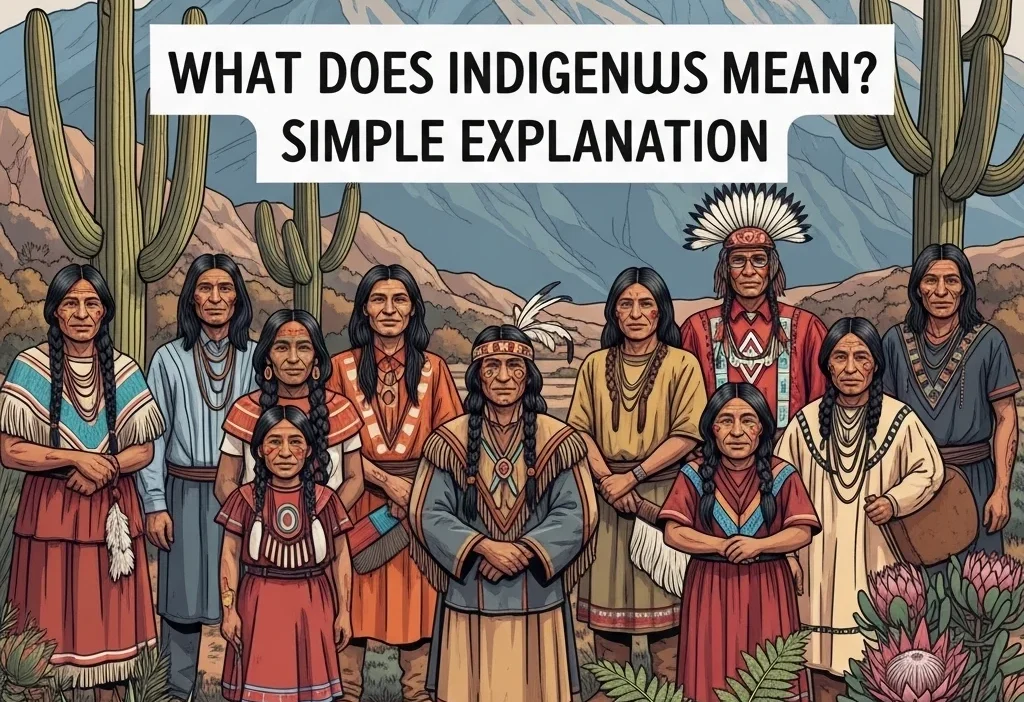
The word indigenous is often used when talking about original communities in countries like Canada, Australia, and the United States.
These groups lived in their lands long before modern countries formed.
The United Nations uses the term “Indigenous Peoples” to describe communities with deep historical roots in their regions.
This meaning is important because it connects to identity, culture, and heritage.
Why Indigenous Is NOT Slang or an Abbreviation
Unlike internet slang like “LOL” or “BRB,” indigenous is a real dictionary word.
It is:
- Not an acronym
- Not internet slang
- Not chat shorthand
Instead, it’s a proper English word used in both formal and informal communication.
However, it still appears in texting culture because people discuss history, nature, and identity online.
Similar Words and Alternatives to Indigenous
Here are words similar to indigenous and when to use them:
| Word | Meaning | When to use it |
|---|---|---|
| Native | originally from a place | casual and general use |
| Local | from nearby area | everyday conversations |
| Aboriginal | original inhabitants | specific cultural contexts |
| Endemic | only found in one place | scientific use |
| Traditional | related to old customs | culture discussions |
| First Nations | indigenous peoples in Canada | specific to Canada |
| Original | first or earliest | casual and general use |
Quick explanation examples:
- Native: “this bird is native to this area”
- Local: “local food tastes amazing”
- Endemic: used more in science than casual chat
Indigenous is more respectful and formal when talking about people and culture.
Why the Word Indigenous Is Important Today
This word matters because it shows respect for original cultures and nature.
People use it to:
- Honor cultural identity
- Protect traditions
- Describe natural ecosystems
- Educate others
It’s common in school, social media, and global discussions.
Using it correctly shows awareness and respect.
FAQ About Indigenous Meaning
1. What does indigenous mean in simple words?
It means originally from a place and naturally belonging there.
2. Is indigenous slang?
No. Indigenous is a real English word, not slang or an abbreviation.
3. Can indigenous refer to animals and plants?
Yes. It can describe plants and animals that naturally grow or live in a place.
Example:
“this plant is indigenous to this region”
4. Is indigenous formal or casual?
It’s usually neutral or formal, but it can appear in casual chats too.
5. Is indigenous the same as native?
They are similar, but indigenous is more formal and respectful, especially for people and cultures.
6. Do people use indigenous on social media?
Yes. It’s common in educational posts, cultural discussions, and travel content.
7. Is indigenous positive or negative?
It’s a respectful and positive word when used correctly.
Indigenous Meaning in Modern Texting Culture
Even though indigenous isn’t slang, it still appears in modern texting and online conversations.
People use it when discussing:
- Cultural identity
- History lessons
- Nature facts
- Travel experiences
Unlike slang that changes quickly, indigenous has a stable and important meaning.
It helps people communicate clearly about origin and belonging.
Final Thought
So, what does indigenous mean? Simply put, it refers to people, plants, animals, or cultures that originally come from and naturally belong to a specific place. It’s not slang or chat shorthand, but it’s still common in online conversations, social media, and texting culture.
The word carries deep meaning, especially when talking about identity, heritage, and nature. Using indigenous correctly shows respect and understanding. As digital communication grows, knowing words like this helps you connect better, learn more, and communicate clearly in both casual and formal situations.

Watson is a naming niche expert and the author at Namefluxs.com, specializing in unique usernames, nicknames, and brand name ideas based on modern trends and user intent.